Akai Fire - The World’s First Hardware FL Studio Controller

We know a lot of you who contribute to Looperman use FL Studio to make your beats and loops. Up until now no one has made a dedicated hardware controller for FL Studio, tailored to it's unique set up and approach to music making. Like Ableton's Push controller, the new Akai Fire is designed specifically for use with FL Studio.
The controller is based around 16 velocity-sensitive RGB controllers, like most controllers, it's designed as 16 step sequencer for drum patterns or instruments
Here's a introduction from Akai themselves:
Akai Fire Modes
There are a lot of smart ways that the controller helps you with your workflow. Akai have split these into the following modes.
- Note Mode : in note mode the pads become a four octave MIDI keyboard.
- Drum Mode : yes, you guessed it. Drum mode replicates the classic flstudio 16 pad step sequencer layout giving you 4 rows of 16 beats to program your beats
- Performance Mode: again performance mode does pretty much what it says on the tin. Allows you to trigger MIDI or audio clips on the fly. Great for using Fire to play live.
Take a look at the next video about the different modes you can use with Fire:
Akai Fire boasts a small navigation window, which will probably be seen as very low-tech in a few years, but at the moment it's a very welcome addition and makes the moving around of samples and sounds a lot easier. Its a pity that this wasn't bigger. maybe they are trying to keep the price point down.
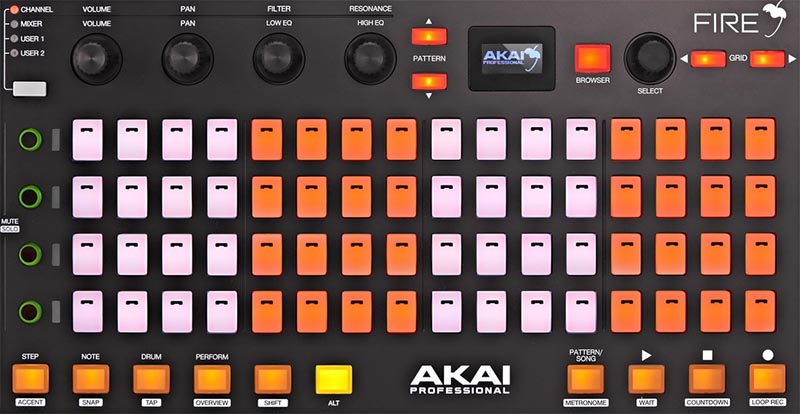
The other thing to take notice of is the Multi Device Mode. You can connect up to four Fire devices together to expand your control over FL Studio, increasing channels and sequencer complexity. This is a very powerful feature and one that you don't get with other controllers such as Ableton Push
Main features and specifications:
- Plug-and-play integration with FL Studio
- Quickly input patterns along the timeline in the step sequencer
- 4 x 16 Matrix of Velocity-Sensitive RGB Pads
- Record notes in Performance mode
- Graphical OLED display
- 4 banks of assignable Touch-Capacitive Knobs
- Instantly navigate the Channel Rack, Browser, Tool Bar and Playlist windows
- Use dedicated controls to quickly browse audio and project files
- Dedicated Transport controls
- USB bus-powered
System requirements
Windows
Windows 7, 8, 10 or later
4GB of RAM or higher recommended
4GB free disk space
FL Studio 20.0.5 or later
Mac OS
10.11 or later
4GB of RAM or higher recommended
4GB free disk space
FL Studio 20.0.5 or later
Coming in at around £180 GBP / $199 USD its a reasonably priced controller and the only dedicated hardware for Flstudio to date.
Has anyone else been able to test one out yet ? We think it looks great and is a well overdue piece of kit for all you Flstudio heads out there.
Leave your thoughts in the comments. We'd love to hear what you think about it.
Comments (9)
Feel free to post your own comment.
Related Posts
You may also be interested in these posts from the blog.
- Introducing The New TRAKTOR KONTROL S4 3
- Steinberg Cubase 10 Released - Whats New 2
- Flstudio Mobile Is Now Available For Free - Heres How To Find It 6
- Akai Fire - The World’s First Hardware FL Studio Controller 9
- Acid Pro 8 Released By Magix 7
- Ableton Link Now Available In Live 9.6 4
- Discover The 10 Tracks That Made The Most Money From Royalties 15
- Happy 30th Birthday MIDI - How MIDI Changed The World Of Music 20
- Jam With Chrome - Play Music Live With Your Friends Online 13
- Making Tracks - Great Documentary On Iconic Recording Studios 4
- Google Honours Robert Moog With Interactive Moog Synthesiser Doodle 4
- Claim Your Free Copy Of Ableton Live Lite 8 18
- John Peels Vinyl Record Collection Goes Online Via The Space 4
- Image Line Launches FL Studio 10.5 Beta With Performance Mode 3
- Andy Manson Rebuilds His Led Zeppelin John Paul Jones Triple Neck Guitar 10
cause this one has a screen? well, you have a large screen right in front of you, which is more convinient to use than this one.
step sequencer? oh, you can record beats with these pads or just draw them, especially since most people use piano roll for beats (not sure why, actually. maybe it's easier for them or idk)
The one useful tool i find is setting the keys to a certain scale, but even then the buttons themselves have a slightly slowed sensitivity reaction. I end up using it to find the basis for a melody but still drawing it in the pianoroll anyway to get the right timing.
The pattern mode is good for boom-bap style only. If you use triplets in your hats or work a lot with 8th, 16th, 32nd notes then again you are back working in the pianoroll.
The drumpad was the thing I was most interested in, but it's a secondary feature. The keys aren't "pads", like a mention before, the touch sensitivity is delayed and will put your timing off and you'll have to draw it in again.
It does look "good on the desk" as RobbinHoodBeats said, and it's cool to use the live looping feature when you got a good loop and you can sit with the artist (or maybe you are the artist) and drop drums and instruments in/out for a good freestyle session.
TL;DR it's easier to use the mouse and draw in the pianoroll.
60 automation for each plugin with mode "override generic link" with only one device.
because : Having bought 4 akai LPD (each with 8 360° pots) so 32 pots in total, I thought I would be able to control 32 buttons of each plugin thanks to the "overide generic link" but every time there were conflicts, a button assigned on one of the controllers was also automatically assigned on another controller without me being able to do anything, like MIDI CC conflicts, and since I'm not well versed in the field I needed a machine with many rotary knobs.
when you assign in generic link: the button of your machine remains connected to the button of the plugin only if the window of the latter is active, because if you click elsewhere in another plugin, at that moment, the connection between the button of the machine and that of the plugin is disabled, it is therefore necessary to display the window of the plugin in the foreground so that the buttons turn ! this is how the overide generic link works, it is just necessary that the window be active. The advantage of the generic link is that you can control as many different plugins without having to do it again on another project because the override generic link is a constant memory on all your projects while the "link to controller" is for a single project...
For the moment it's the cheapest one I've found with so many buttons.
I normally receive it in a few days.
Why would use this instead of a Maschine or a Touchpad?
it's not ready for performance mode LIVE LOOPING in real time.
Certainly now on NEWTONE you can use warp like ableton : stretch shrink wave. the only difference is that you only control shortcuts that you could just as easily use with the mouse, nothing extraordinary.